A data center you can fit on a flatbed.
SolarNodes is a proof that serious AI inference doesn't require a warehouse, a grid connection, or a fossil fuel bill. Node 01 is a used 20-foot shipping container converted into a solar-powered micro data center — built by hand, off-grid, on a mountain ridge.
From shipping container to micro data center.
Node 01 began as a standard used 20-foot ISO shipping container — the kind that moves cargo across oceans and then sits in a yard. We bought one, cut it open, and rebuilt it from the inside out to house GPU compute, battery storage, networking gear, and the power electronics that tie it all together.
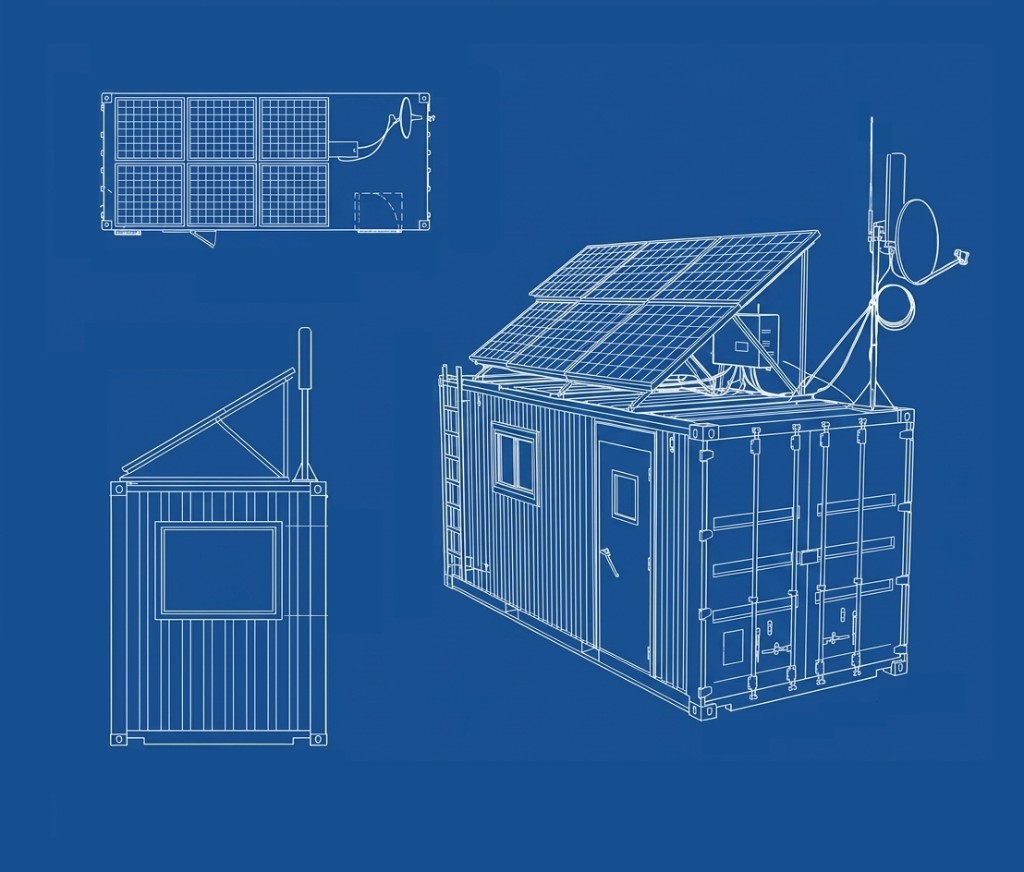
Structure & layout
The container was reinforced, leveled on a steel frame, and divided into thermal zones: a hot aisle for compute, a cool intake path for alpine air, and a dedicated enclosure for batteries and inverters. Every component was chosen to fit within the 160 square feet of floor space a 20-footer gives you.
Solar & storage
A ground-mounted solar array feeds the container through a custom-built distribution system — not an off-the-shelf panel board, but a purpose-designed bus that routes DC from the array to charge controllers, inverters, and the battery bank that carries the cluster through nights and cloudy hours.
Compute rack
Inside, a compact GPU rack runs open-weight models for inference. The hardware draws hard when it runs, so every watt is accounted for — scheduled against solar yield, buffered by batteries, and cooled before heat becomes a problem.
Off-grid by design
There is no utility connection. No diesel generator on standby. The container has to generate, store, distribute, and consume its own power — and stay online long enough to serve useful inference. That constraint shaped every decision in the build.
Nothing about this site was plug-and-play.
Building a data center in a shipping container on a remote ridge meant solving problems that hyperscale facilities never think about.
Long-range connectivity
The site has no fiber run and no cell tower in line of sight. We deployed a point-to-point wireless antenna to beam a high-bandwidth link across the valley to a relay with backhaul — essentially building our own last-mile network so the container could serve API traffic without trenching cable up the mountain.
Insulation & cooling
A steel box on a sunny slope is a greenhouse. We insulated every surface — walls, ceiling, and floor — with closed-cell foam to stop thermal bridging, then built a ducted cooling system that pulls cold alpine air through filtered intakes and exhausts hot air from the GPU rack. The goal: keep silicon below throttle temperature without running compressors that would eat the solar budget.
Load balancing & optimization
We built a custom distribution system to load-balance and optimize the tiny server against real-time solar yield. It meters every circuit, routes power to batteries or compute based on what's available, and gives the cluster the telemetry it needs to throttle workloads, schedule inference, and stay online without pulling more than the array can produce.